
17-4PH Fasteners: H900 vs H1025 vs H1150 vs H1150D — Bolts, Nuts, Screws, Studs and Washers in Real Service
17-4PH is one of the most specified high-strength fastener alloys in the world, and one of the most frequently mis-specified. The same base chemistry can deliver 1310 MPa tensile strength or 860 MPa, 47 HRC or 31 HRC, a joint that survives a decade in sour gas or a thread-root crack within months — because the aging condition, not the alloy name, determines the outcome. This guide separates the four conditions that matter for fasteners, documents the failure cases that shaped current specification practice, and maps 17-4PH fasteners across aerospace, oil and gas, medical, chemical, marine and nuclear service.
1. What 17-4PH Is — and What the “Condition” Actually Does
17-4PH (UNS S17400, ASTM A564 Type 630, EN 1.4542) is a martensitic precipitation-hardening stainless steel containing approximately 15–17.5% chromium, 3–5% nickel, 3–5% copper and 0.15–0.45% niobium plus tantalum. It is not a solid-solution alloy like 316 stainless, and it is not a conventional quench-and-temper steel. It starts as a low-carbon martensitic matrix supersaturated with copper and niobium, and it derives its strength from the precipitation of fine copper-rich phases during a controlled aging treatment.
The practical consequence for fastener procurement is that “17-4PH” without a condition is an incomplete specification. Every 17-4PH fastener begins in the solution-annealed Condition A, which is soft and ductile and unsuitable for service. The aging temperature then determines the size and distribution of the precipitates, and therefore the entire strength–toughness–corrosion-resistance envelope. H900, H1025, H1150 and H1150D are not minor temper variations. They are distinct engineering materials with different failure modes.
2. The Four Conditions Compared: Strength, Hardness and Environmental Limits
The table below consolidates the minimum mechanical properties and the environmental boundaries that govern fastener selection. The hardness column is the single most important line for any joint exposed to hydrogen — whether from H₂S, cathodic protection or plating.
2.1 H900 — peak strength, minimum environmental margin
H900 delivers the maximum attainable strength and hardness in 17-4PH: minimum 1310 MPa tensile, 1170 MPa yield, and 40–47 HRC. The precipitation of extremely fine, coherent copper clusters provides exceptional dislocation pinning. But this microstructure also exhibits the lowest ductility, the highest notch sensitivity, and the poorest resistance to both sulfide stress cracking and hydrogen embrittlement among the common aging conditions. H900 fasteners are strictly prohibited in any H₂S-containing environment under NACE MR0175, and they are vulnerable to hydrogen-induced cracking even outside formal sour service if hydrogen is generated by galvanic corrosion, cathodic protection or electroplating.
2.2 H1025 — the engineering balance point
H1025 (aged at 550 °C) is a slight overaging step that allows precipitates to grow marginally and relieves some lattice strain. It retains a high strength level — minimum 1070 MPa tensile, 1000 MPa yield, 35–42 HRC — while significantly improving toughness, elongation and corrosion resistance relative to H900. It is widely considered the optimum balance for high-performance industrial fasteners that are not exposed to sour environments. H1025 is still not acceptable for NACE MR0175 sour service because its hardness range overlaps and exceeds the 33 HRC ceiling for 17-4PH in H₂S.
2.3 H1150 and H1150D — where sour-service compliance lives
H1150 (aged at 620 °C) coarsens the precipitates substantially and forms a measurable amount of stable reversed austenite along martensite lath boundaries. Strength drops notably — minimum 930–1000 MPa tensile and 725 MPa yield — but resistance to chloride stress-corrosion cracking and hydrogen-induced cracking rises dramatically.
H1150D is the double-aged version of H1150: the material is aged at 620 °C for four hours, air-cooled, then given a second identical aging cycle at 620 °C. The double thermal exposure ensures more complete transformation and stress relief, producing a stable microstructure with maximum resistance to sulfide stress cracking and hydrogen embrittlement. H1150D is the only 17-4PH condition unconditionally accepted by NACE MR0175 for critical sour service components, including fasteners exposed to H₂S-containing environments, with a maximum hardness of 33 HRC and a minimum yield of approximately 725 MPa. That is still roughly twice the strength of 316 stainless steel, which is why H1150D is the practical default for sour-service fasteners rather than a step down to a lower-strength alloy.
3. Failure Cases That Define the Specification Rules
The condition rules for 17-4PH fasteners were not derived from first principles alone. They were written after failures, and two of those failures are directly relevant to anyone specifying a bolt, stud or nut today.
On a Titan launch vehicle, high-strength 17-4PH bolts in the H900 condition were used to clamp an aluminum alloy 7075-T6 oxidizer valve forging. After exposure to the marine atmosphere at Cape Canaveral, the bolts were found to be cracking. Laboratory investigation showed the failure was not stress-corrosion cracking but hydrogen-induced cracking: galvanic corrosion between the steel bolt and the aluminum forging released hydrogen into the high-hardness steel, and the bolts cracked in a brittle intergranular mode.
The corrective actions included over-aging the bolts, vacuum-deposited coating, anodizing the aluminum alloy, and barrier lubricants. The lesson for fastener engineers is not that 17-4PH is unsuitable for aerospace — it is widely used there. The lesson is that a correct material certificate does not protect a joint from an incorrect galvanic design, and that H900’s hydrogen sensitivity extends beyond formal sour-service definitions into any joint where hydrogen can be generated.
A natural gas project in the Middle East experienced multiple valve bonnet bolt failures within six months of commissioning. The fasteners were supplied as “17-4PH” but were inadvertently provided in the H900 condition, with hardness averaging 42 HRC. In the wet, sour gas environment, sulfide stress cracks initiated at the thread roots and led to catastrophic brittle fracture. After root-cause analysis, the operator replaced all critical fasteners with 17-4PH H1150D studs, with full PMI and 100% hardness verification. No further SSC failures were reported in over three years of continuous operation.
This is the condition trap in its purest form: the purchase order said “17-4PH,” the mill certificate said “17-4PH,” and the fasteners still failed — because the condition was not specified, not verified on the finished part, and not matched to the environment.
4. Aerospace and Defense
17-4PH fasteners are extensively used in aircraft engines, landing gear components and structural assemblies where a high strength-to-weight ratio and corrosion resistance are both required. The alloy is specified for landing gear parts, engine and turbine components, and structural fasteners requiring high strength and corrosion resistance, and it appears in military and naval critical hardware. Aerospace procurement typically references AMS 5643 alongside ASTM A564, and dimensional standards such as AS8879 for threads and NAS/MIL specifications for self-locking nuts and washers.
The condition choice in aerospace depends on the joint. H900 and H1025 are common for high-strength structural fasteners in benign or protected environments. H1150 is used where stress-corrosion resistance or toughness is a priority. The Titan launch-vehicle failure is the standing reminder that galvanic coupling to aluminum structure and marine-atmosphere exposure can turn a benign-environment assumption into a hydrogen-embrittlement problem, and that coating and joint-design measures are part of the fastener specification rather than an afterthought.
5. Oil and Gas: The H1150D Domain
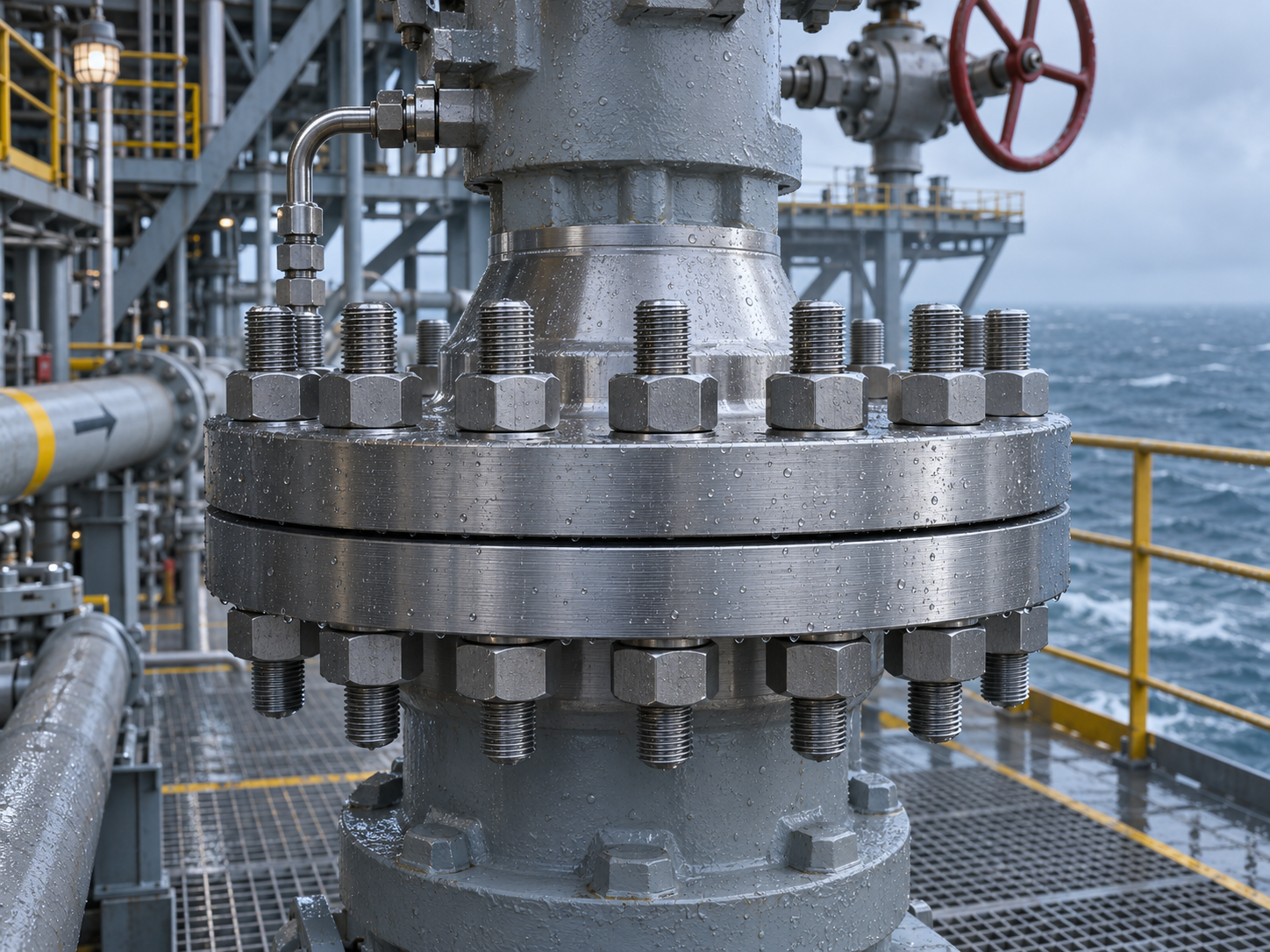
Oil and gas is the application area where 17-4PH condition selection is most consequential, and where H1150D has become the default for sour service. Fasteners in API 6A gate valves, choke bodies and subsea trees must maintain gasket seating under 10,000–15,000 psi, resist H₂S partial pressures often exceeding 10 psi, tolerate chloride-rich produced water and survive thermal cycling between shut-in and production. H900 and H1025 are not acceptable in this environment; H1150D is the condition that combines the required strength with demonstrated SSC resistance.
5.1 Valve, wellhead and manifold bolting H1150D
RAYCHIN’s sour-service application data identify API 6A gate valve bonnet and flange bolting, subsea valve actuator mounting fasteners, Christmas tree connector studs and high-pressure manifold clamp bolts as core H1150D fastener applications. Christmas tree connector studs can be supplied up to M64 / 2-1/2″. The fastener forms are heavy hex bolts and nuts, large-diameter studs, and clamp bolts selected for fatigue and relaxation resistance under pulsating pressure.
5.2 Downhole tools and completion hardware
17-4PH is used in downhole tools, pump shafts, valve components and offshore platform hardware where high strength and moderate corrosion resistance are required. In non-sour or mildly sour downhole environments, H1025 or H1150 may be specified where the operator permits; in H₂S-containing completions, H1150D is the compliant choice. The procurement rule remains: the condition must be on the purchase order and verified on the finished part, not inferred from the alloy name.
6. Medical Devices and Surgical Instruments
17-4PH is used in surgical instruments and medical devices requiring biocompatibility and sterilization resistance, as well as in implants and instrument articulation joints. Surgical instrument components — pivot assemblies, articulation joints, shuttles and fasteners — benefit from the alloy’s combination of strength, wear resistance and corrosion resistance after repeated autoclave cycles. In laparoscopic and other minimally invasive instruments, 17-4PH articulation joints and pivot fasteners must maintain mechanism precision in a small envelope, and the alloy’s high fatigue and wear resistance supports that requirement.
For medical fasteners, H900 and H1025 are common in instrument applications where high hardness and wear resistance are needed. Where the component is implanted or exposed to chloride-bearing body fluids for prolonged periods, the same SCC and hydrogen-embrittlement considerations that govern sour service apply in principle, and the condition and surface finish should be selected with the same discipline. RAYCHIN supplies 17-4PH machine screws, fasteners and precision components for instrument and device assemblies in the conditions specified by the device engineer.
7. Chemical Processing, Marine and Nuclear
7.1 Chemical processing H1025 / H1150
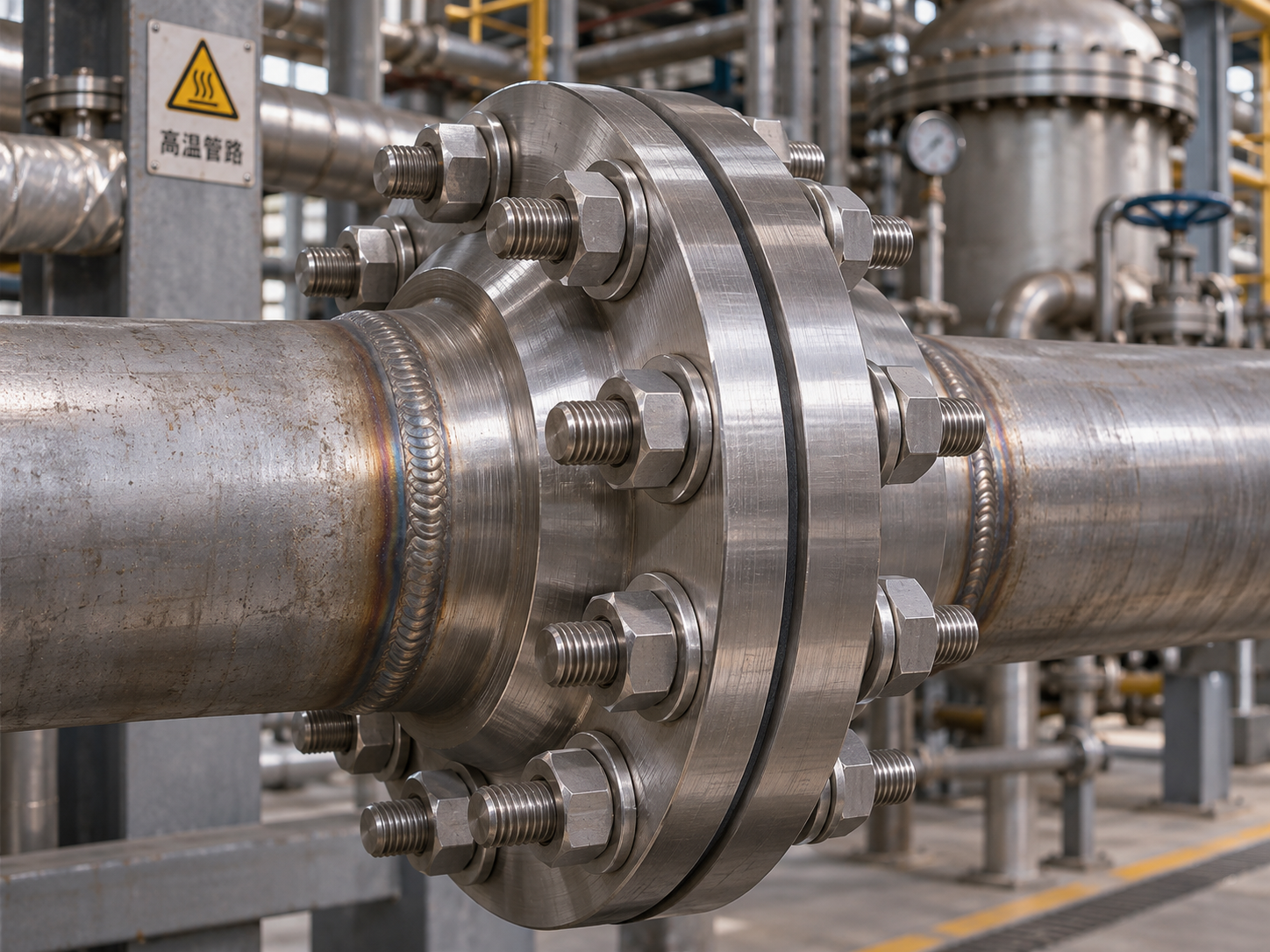
17-4PH fasteners are used in pumps, valves and processing equipment handling mildly corrosive media, and in heat exchangers and pressure vessels where high mechanical strength is required. The alloy’s corrosion resistance is generally comparable to Type 304 stainless in many environments, so it is not a substitute for a nickel alloy in aggressive acid or chloride service. Its advantage is the ability to carry high load in a corrosive-but-moderate environment where 304 or 316 would be strength-limited.
7.2 Marine engineering
17-4PH is used in marine fasteners, propeller shafts, rudder stocks, pump components and high-strength fittings where resistance to saltwater corrosion and high strength are both needed. In continuously immersed or splash-zone service, the same crevice-corrosion and galvanic-coupling discipline that applies to other high-strength alloys applies to 17-4PH: the fastener’s own corrosion resistance does not protect it from a poorly designed couple to a less noble material.
7.3 Nuclear and power generation
17-4PH is used in nuclear reactor components, valve stems and power-generation hardware, and in dry casks for storing spent nuclear fuel. Threaded rods and nuts in 17-4PH are employed in turbine components and nuclear power plant applications. In these applications, the condition is selected against the temperature and environmental requirements of the specific component, and the traceability and certification requirements are correspondingly stringent.
8. Engineering Constraints: Galling, Galvanic Coupling and Temperature
8.1 Thread galling
17-4PH is highly prone to thread galling during installation, particularly in the H900 condition where hardness is high. A scratched or galled thread in a high-hardness fastener becomes a stress riser, and assembly can seize before the target preload is reached. Control measures include molybdenum-disulfide-based anti-seize compounds, solid-film lubricants, silver plating, or pairing the 17-4PH bolt with a nut of a different material or hardness where the design permits. RAYCHIN can supply fasteners with pre-applied anti-seize or solid-film lubrication and provides assembly guidance for high-strength joints.
8.2 Galvanic coupling and hydrogen
The Titan launch-vehicle failure is the canonical example of a galvanic coupling that generated hydrogen and cracked a high-hardness 17-4PH bolt. The general rule is that 17-4PH should not be coupled to aluminum or other active metals in a way that promotes hydrogen evolution at the fastener surface without a barrier. Coatings, sealants, anodizing of the mating aluminum, and over-aging the fastener are the standard mitigations. In cathodically protected structures, the same logic applies: the CP current can generate hydrogen on a high-strength fastener, and the condition and coating must be selected with that in mind.
8.3 Temperature
17-4PH maintains useful strength up to approximately 300–315 °C, with good mechanical properties and toughness at temperatures up to about 310 °C. Above that range, alternative alloys should be considered. This is one of the boundaries between 17-4PH and nickel-based alloys such as Inconel 718 or A286 in high-temperature aerospace and power-generation joints.
9. RAYCHIN LIMITED: 17-4PH Fastener Manufacturing and H1150D Sour-Service Capability
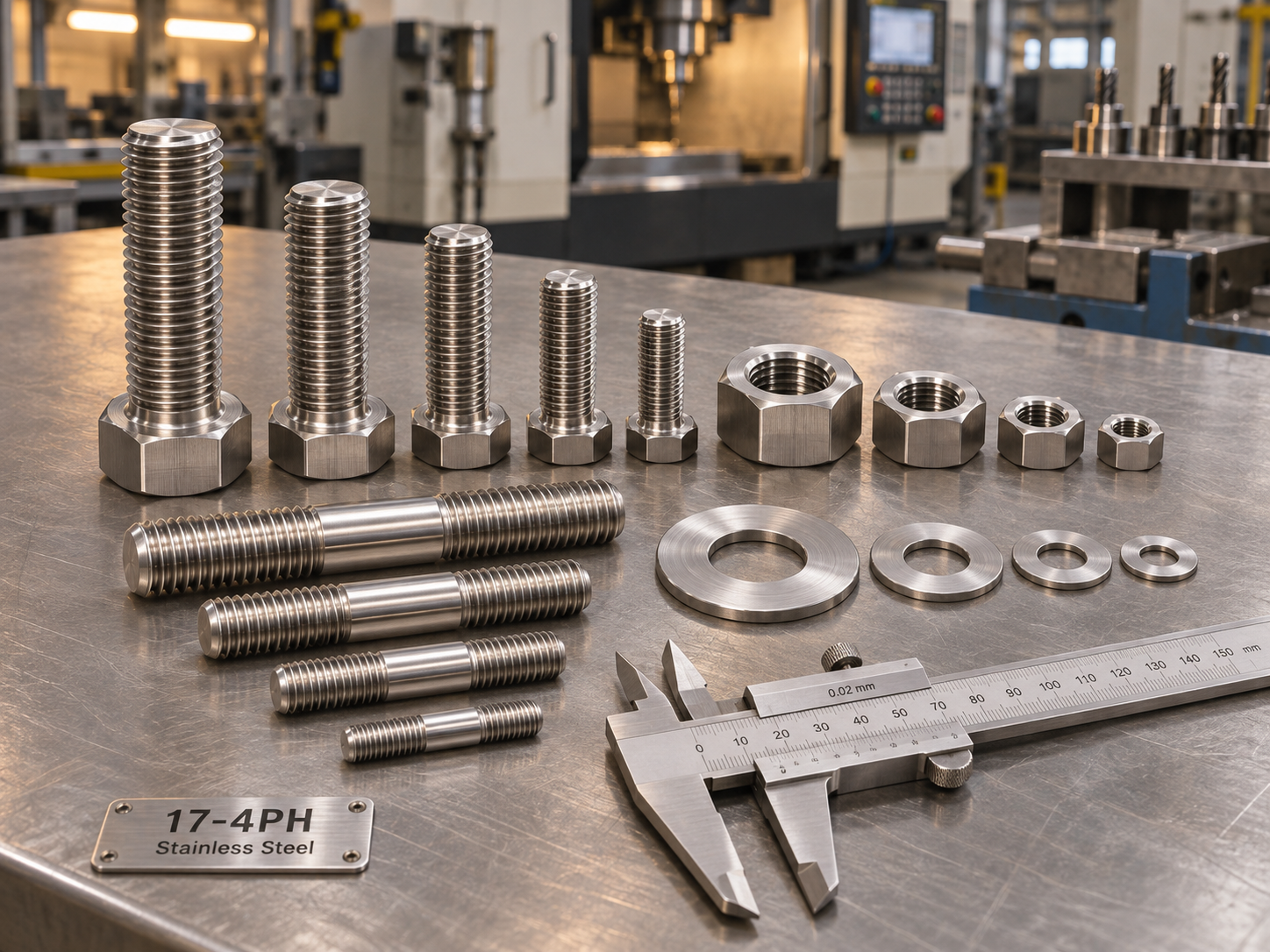
RAYCHIN LIMITED manufactures 17-4PH fasteners as a direct factory source, with in-house control over solution annealing, aging, machining, thread rolling and final verification. The company’s 17-4PH product range covers bolts, hex cap screws, socket head cap screws, machine screws, nuts, lock nuts, washers, fully threaded and double-end studs, threaded rod and custom CNC components, in metric and imperial sizes.
The critical capability for oil and gas customers is H1150D compliance, and RAYCHIN’s quality plan is built around it: in-house vacuum heat treatment with digital furnace records, certified raw material from NACE-compliant mills, 100% hardness testing on every fastener (not lot sampling), PMI by optical emission spectroscopy to confirm UNS S17400 chemistry, lot-specific tensile testing after final heat treatment, and an explicit NACE MR0175 compliance statement on the material certificate. EN 10204 Type 3.2 certification with independent third-party witness inspection is available.
RAYCHIN manufactures 17-4PH fasteners to ASTM A564 Type 630, AMS 5643 and DIN 1.4542, and supplies H900, H1025, H1075, H1150 and H1150D conditions. The company’s metallurgical team can advise on condition selection against the service environment, galvanic-coupling risk, galling-control measures and documentation requirements, rather than supplying a fastener certificate without context.
10. Frequently Asked Questions
Which 17-4PH condition is acceptable for NACE MR0175 sour service?
H1150D is the only 17-4PH condition unconditionally accepted by NACE MR0175 / ISO 15156 for critical sour service components, including fasteners exposed to H₂S. It requires a double aging treatment at 620 °C (1150 °F) and a maximum hardness of 33 HRC. H900, H1025 and H1075 are explicitly not acceptable for sour service under NACE MR0175. H1150 may be conditionally accepted on a case-by-case basis if hardness is strictly controlled, but most operators default to H1150D to eliminate the risk.
What is the strongest 17-4PH condition and why is it not always the best choice?
H900 (aged at 480 °C) delivers the highest strength in 17-4PH, with minimum tensile strength of 1310 MPa (190 ksi), yield of 1170 MPa (170 ksi) and hardness of 40–47 HRC. However, it also has the lowest ductility, the highest notch sensitivity and the poorest resistance to sulfide stress cracking and hydrogen embrittlement. H900 fasteners are strictly prohibited in H₂S-containing environments and are vulnerable to hydrogen-induced cracking even outside formal sour service if hydrogen is generated by galvanic corrosion or plating. H1025 is the engineering balance point for high-strength industrial fasteners not exposed to sour environments.
Why did 17-4PH bolts fail on a launch vehicle and what does it teach about galvanic coupling?
High-strength 17-4PH H900 bolts on a Titan launch vehicle's aluminum oxidizer valve cracked after exposure to the marine atmosphere at Cape Canaveral. The failure was hydrogen-induced cracking, not stress-corrosion cracking, caused by galvanic corrosion between the steel bolt and the aluminum alloy 7075-T6 forging it clamped. Hydrogen released by the galvanic reaction entered the high-hardness steel and caused brittle failure. The recommended fix included over-aging the bolts, vacuum-deposited coating, anodizing the aluminum, and using barrier lubricants — a reminder that a correct material certificate does not protect a joint from an incorrect galvanic design.
Is 17-4PH prone to thread galling and how is it controlled?
Yes. 17-4PH is highly prone to thread galling during installation, particularly in the H900 condition where hardness is high. Control measures include molybdenum-disulfide-based anti-seize compounds, solid film lubricants, silver plating, or pairing the 17-4PH bolt with a nut of a different material or hardness where the design allows. RAYCHIN can supply fasteners with pre-applied anti-seize or solid-film lubrication and provides assembly guidance for high-strength 17-4PH joints.
Can RAYCHIN supply 17-4PH fasteners in all conditions?
Yes. RAYCHIN LIMITED manufactures 17-4PH bolts, nuts, screws, studs, washers and threaded rod to ASTM A564 Type 630, AMS 5643 and DIN 1.4542, in H900, H1025, H1075, H1150 and H1150D conditions. For H1150D sour-service fasteners, RAYCHIN performs 100% hardness verification, PMI by OES, lot-specific tensile testing, and supplies NACE MR0175 compliance statements with EN 10204 Type 3.2 certification available with third-party witness.
Specify the Condition, Not Just the Alloy
Send your service environment, H₂S partial pressure if applicable, temperature, load, galvanic-coupling details and certification requirements to RAYCHIN LIMITED. Our metallurgical team will confirm whether H900, H1025, H1150 or H1150D is the correct condition, define the hardness and testing requirements, and build a certification package that proves what you received.